
Comparative Fault in the Northeast: Where Massachusetts Draws the Line
Can you still get paid if the accident was partly your fault? In Massachusetts, yes, as long as you were not more at fault than the other side. The law lowers what you get by your share of the blame. It cuts you off only when your share is greater than everyone else's added together. At exactly 50%, you still collect half.
Cross a state line and the answer changes. Two neighbors pay you something at any level of fault. One cuts you off as soon as the fault is even. The map below shows all nine Northeast states. The rest of this post explains what the Massachusetts rule means for an injury claim in Springfield or Westfield.
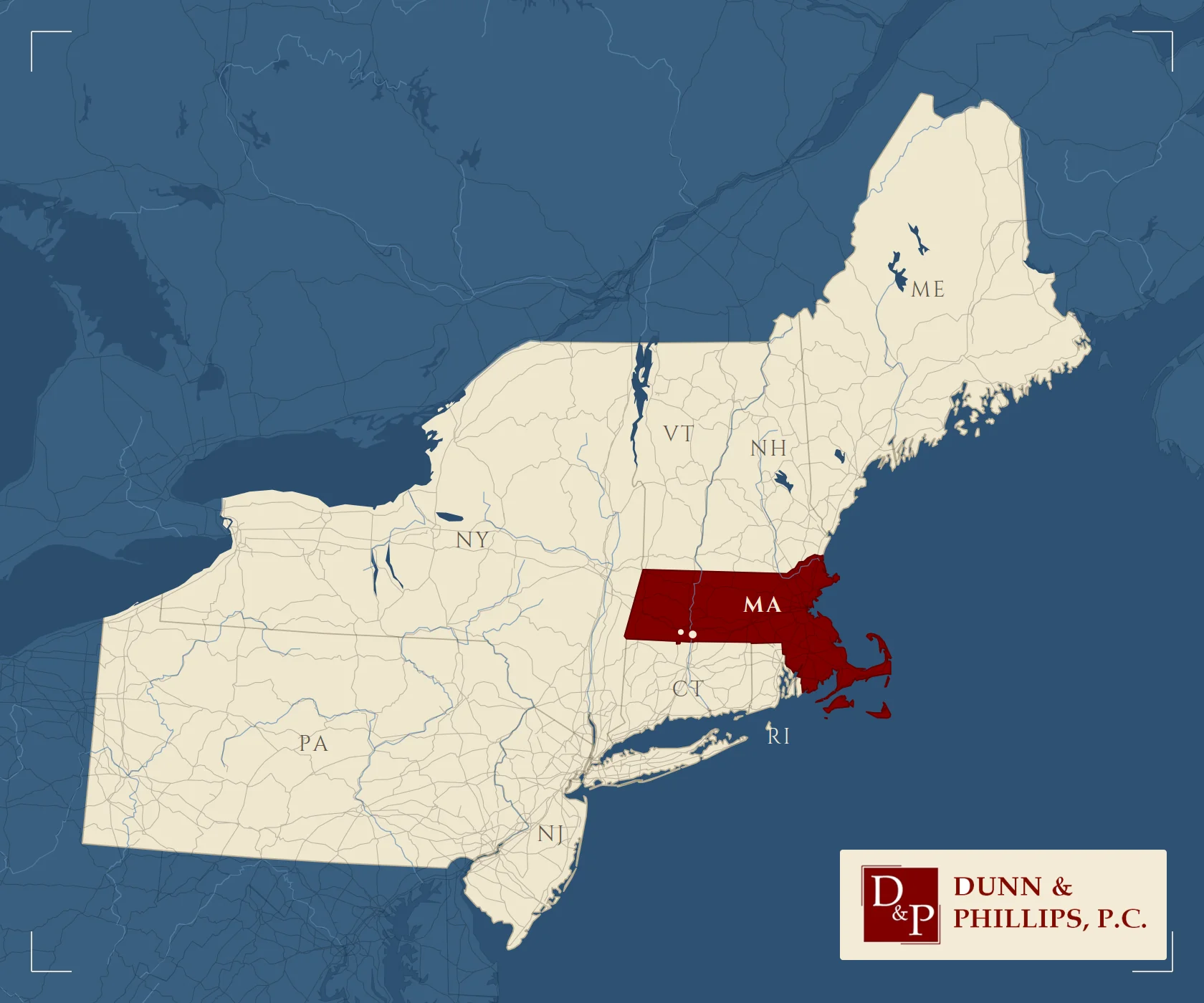
How Massachusetts law treats shared fault
Massachusetts uses a rule lawyers call modified comparative negligence. Negligence means not using reasonable care. The rule is in one law, M.G.L. c. 231, § 85, and it comes down to three points.
- The rule. A jury gives each side a percentage of the fault. You can recover money as long as your negligence is not greater than the total negligence of the people you are suing, added together. Fifty percent recovers; fifty-one does not.
- The reduction. If you are under the line, your award goes down by your share. If a jury awards $100,000 and puts 20% of the fault on you, you get $80,000.
- Who decides. Insurance adjusters, the people who decide claims for insurance companies, assign fault first. They assign it in their own favor. A jury decides only if the case goes that far. Most cases settle, so the adjuster's number is usually the one that matters.
If it was a car accident, Massachusetts no-fault rules add steps of their own. Our car accident page explains how they work.
The Northeast, state by state
In the table, "barred" means you get nothing.
| State | Rule | What it means for you | Authority |
|---|---|---|---|
| Massachusetts | Modified comparative | Barred only if your negligence is greater than the total of the people you sue. 50% still recovers. | M.G.L. c. 231, § 85 |
| Connecticut | Modified comparative | Barred if yours is greater than the combined negligence of the people you sue. 50% recovers. | C.G.S. § 52-572h |
| Rhode Island | Pure comparative | No bar. Your damages go down by your share, whatever it is. | R.I. Gen. Laws § 9-20-4 |
| New Hampshire | Modified comparative | Barred if yours is greater than the fault of the people you sue, added together. 50% recovers. | RSA 507:7-d |
| Vermont | Modified comparative | Barred if yours is greater than the causal total negligence of the people you sue. 50% recovers. | 12 V.S.A. § 1036 |
| Maine | Modified, equal-fault bar | Barred if you are equally at fault. Otherwise the jury lowers your award by a dollar amount it finds just and fair, not by a strict percentage. | 14 M.R.S. § 156 |
| New York | Pure comparative, one carve-out | No bar in general. In auto injury cases under the no-fault law, barred if your culpable conduct (blameworthy conduct) is greater than the combined conduct of the people you sue. | CPLR 1411(a), (b) |
| New Jersey | Modified comparative | Barred if yours is greater than the combined negligence of the people you sue. 50% recovers. | N.J.S.A. 2A:15-5.1 |
| Pennsylvania | Modified comparative | Barred if yours is greater than the combined causal negligence of all the people you sue. Equal fault recovers. | 42 Pa.C.S. § 7102 |
Two details change the answer in crashes with several cars. Most of these states compare your fault to that of all the people you sue, added together. New Hampshire and Connecticut also count people who have settled and people who are immune, meaning the law protects them from being sued, in that total. New Jersey and Pennsylvania also use a separate 60% line. It decides whether one defendant pays the whole judgment or only its share. That is a different question from whether you recover at all.
Hurt in a neighboring state? Where the crash happened usually matters most. But a Massachusetts court looks at every state's connection to the case before it decides whose law applies. So get advice before you assume which rule you are under.
Why two percentage points decide everything
Same crash, same $100,000 verdict, four jurisdictions, meaning four places with their own laws.
| Fault assigned to you | Massachusetts | Rhode Island, or New York outside auto cases | New York auto case | Maine |
|---|---|---|---|---|
| 49% | $51,000 | $51,000 | $51,000 | Jury sets a just and fair dollar reduction |
| 50% | $50,000 | $50,000 | $50,000 | $0 |
| 51% | $0 | $49,000 | $0 | $0 |
In Massachusetts, the fight over a few percentage points is the whole case. That is what the adjuster is doing when the first letter says you were "partly responsible." These things can move the number: the police report, witness statements, photos, dash-cam video, and anything the other driver admitted at the scene.
What to do in the first week
In the first week, fault gets assigned in an informal way, and it is hard to change later. Every step below protects your percentage.
- Do not give a recorded statement to the other side's insurance company. Every "I guess I could have..." becomes a percentage.
- Get the police report number and ask for the report.
- Take photos of everything that shows what the other side did: skid marks, the traffic signal, the dog's fenced area, the wet floor with no sign.
- Write down the names of witnesses before they leave.
- See a doctor and follow the treatment plan. Gaps in treatment get read as "not that hurt," and that carries over into arguments about fault too.
- Call a lawyer before you talk to the adjuster, not after.
Fees
We take injury cases on a contingency fee, and there is no upfront cost. At your free consultation, we explain the percentage and what happens with case expenses.
Why people across Massachusetts call Dunn & Phillips
Offices at 185 Belmont Avenue, Springfield and 56 Washington Street, Westfield, with off-street parking in Westfield. A 24-hour injury line at (413) 426-8657. In-house help in Spanish, Turkish, Russian, Ukrainian, Chinese, and French. Serving injured people across Massachusetts for over 30 years.
This post is general information about the law of Massachusetts and nearby states as of October 2026. It is not legal advice about your situation. Prior results do not guarantee a similar outcome. Attorney Advertising. Dunn & Phillips, P.C., 185 Belmont Ave, Springfield, MA 01108 · 56 Washington St, Westfield, MA 01085.
Frequently asked questions
In Massachusetts, can I get paid if the accident was partly my fault?
What happens if the insurance company says I was 50% at fault?
Who decides what percentage of fault I have?
I live in Massachusetts but was hurt in Connecticut, New York, or New Hampshire. Which rule applies?
Does comparative fault apply to slip and fall and dog bite cases, or only car accidents?
Can my own insurance company use my fault percentage against me?
Is there a deadline to dispute a fault finding?
These answers are general information, not legal advice, and do not create an attorney-client relationship.
Questions about a deadline or a potential claim are best answered early. An initial conversation with the firm is confidential and without obligation.
More on Personal Injury
- When Can an Injured Worker Sue the General Contractor? The SJC Answers in Suquilanda v. Skyway Roofing Suquilanda v. Skyway Roofing, 498 Mass. 164 (2026), applies the Corsetti retained-control test and closes the negligent hiring route for a subcontractor's own employee on these facts. What the SJC held, what it left open, and what it means for injured workers in Massachusetts.
- What to Do in the First 24 Hours After a Car Accident in Massachusetts The steps you take right after a crash can protect your health and your claim. Here is a clear, plain-language guide for the first day.